H2Know: Plant Care IoT

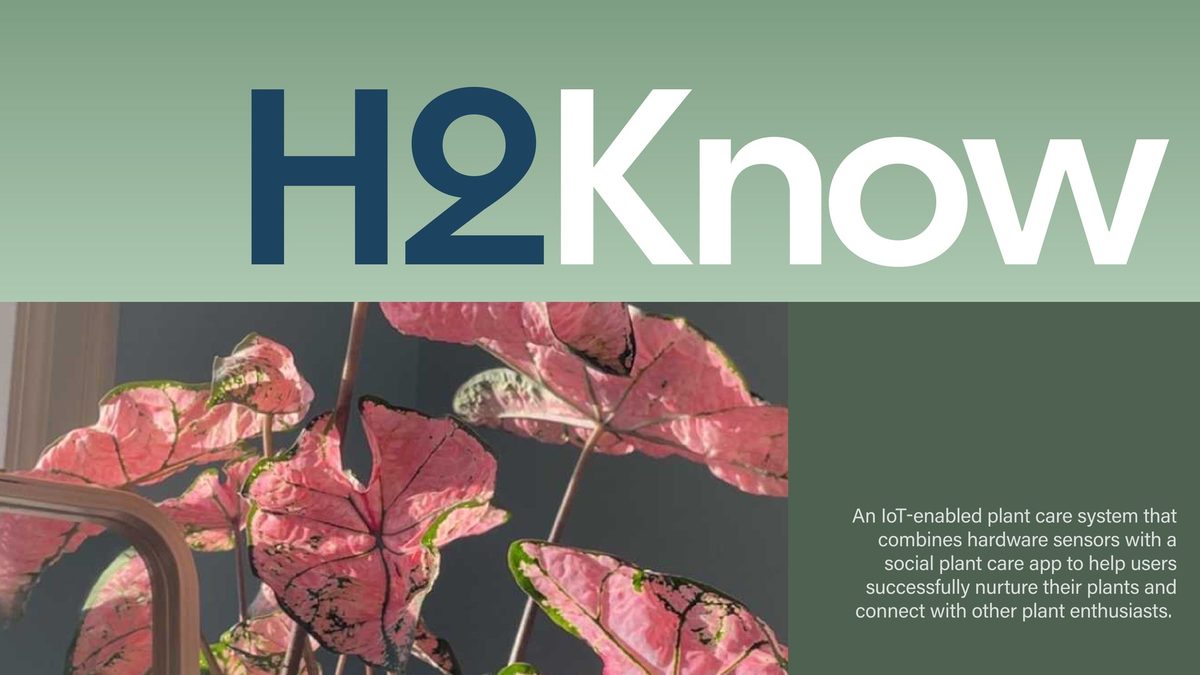
H2Know: plant care IoT system cover slide
Arduino App Design IoT UX Research 2024
Role Solo Designer
Timeline 6 weeks · 2024
Tools Figma · Arduino · Illustrator
Methods User Interviews · Prototyping · IoT
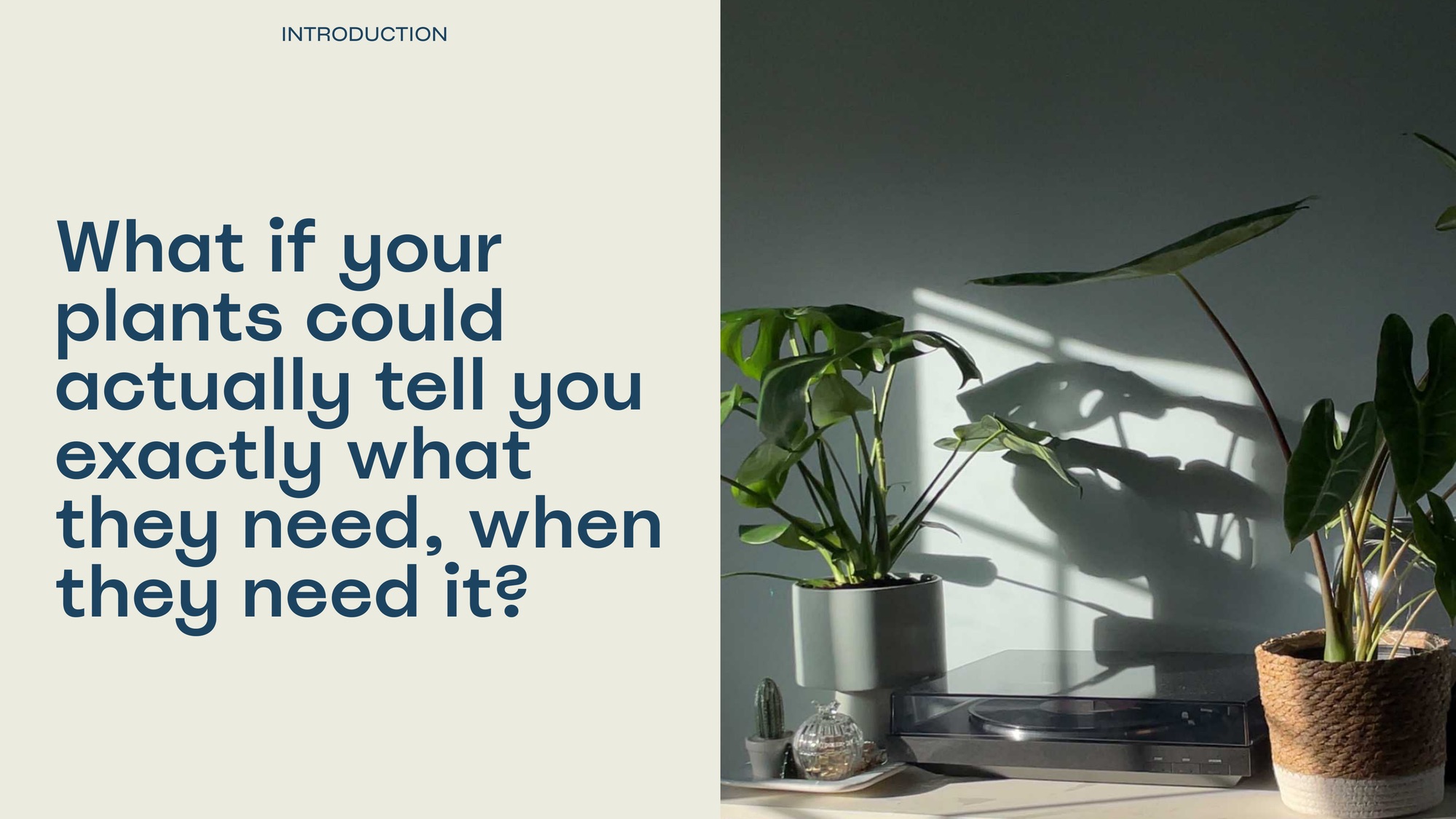
What if your plants could actually tell you exactly what they need, when they need it?

The design question that started the project

01

Your plant can't tell you it's thirsty.

Americans spent over $48 billion on indoor plants in 2024, and 67% of millennial plant owners call themselves "plant murderers." The cause is distance. A plant sits in a corner, behind a desk, out of your sightline, and it can't tell you anything until it's already dying.

The products meant to fix this fall short. Smart pots cost $80 and up, basic moisture meters spit out numbers you can't read, and reminder apps nag you like every other notification. You don't water a plant because you're missing information; you water it because you care whether it lives.
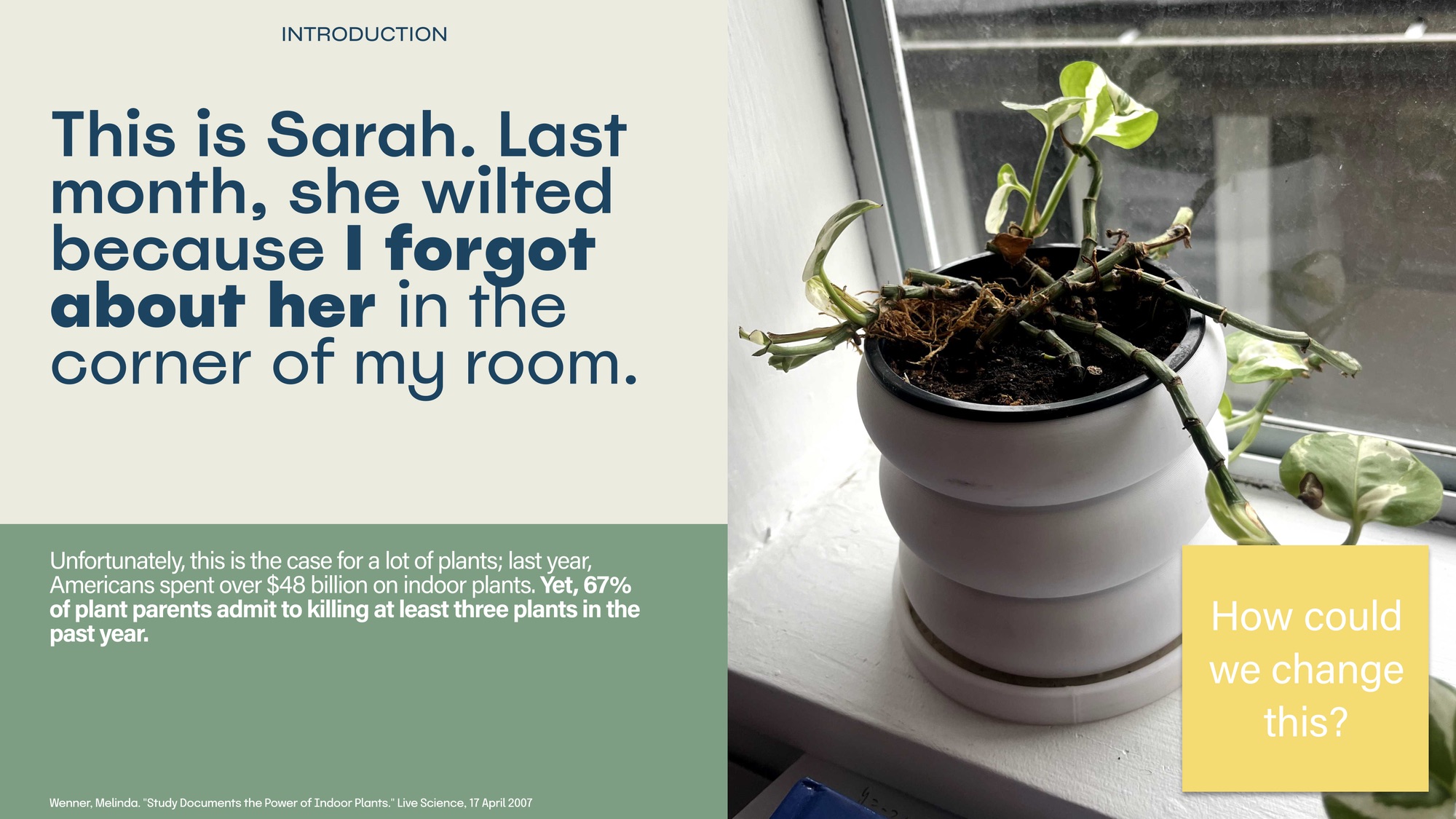
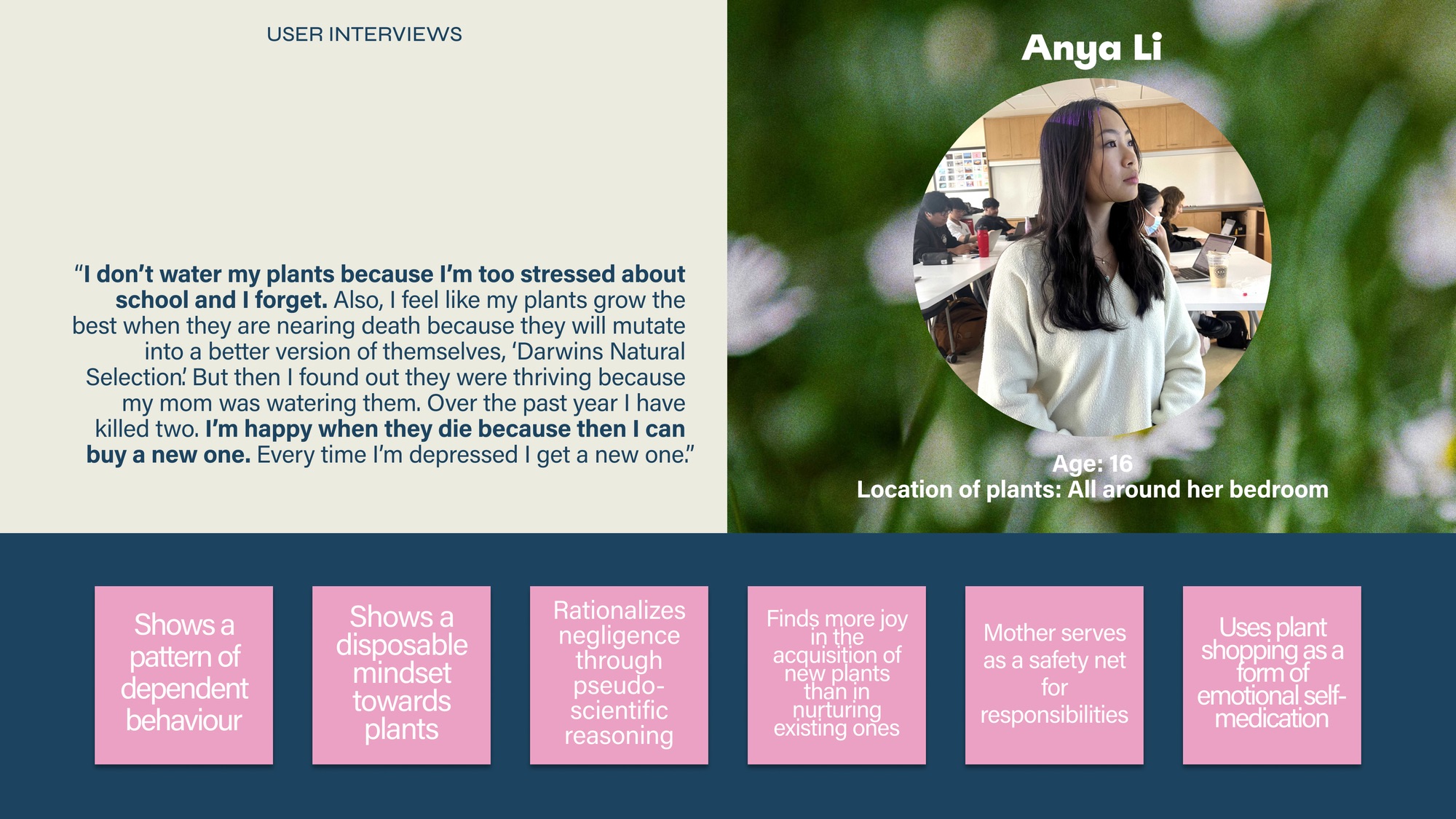
"I'm happy when they die because then I can buy a new one. Every time I'm depressed I get a new one."
Anya Li, 16 · Interview participant
HMW Motivate users to water plants in a non-invasive, helpful way?
HMW Educate users about their specific plants without overwhelming them?
HMW Create a straightforward, familiar interface that requires no learning curve?
HMW Create a stronger emotional bond between owners and their plants?
H2Know: what if your plants could tell you what they need?

Fig. 01: Project framing: giving plants a voice

02

People don't forget. They disconnect.

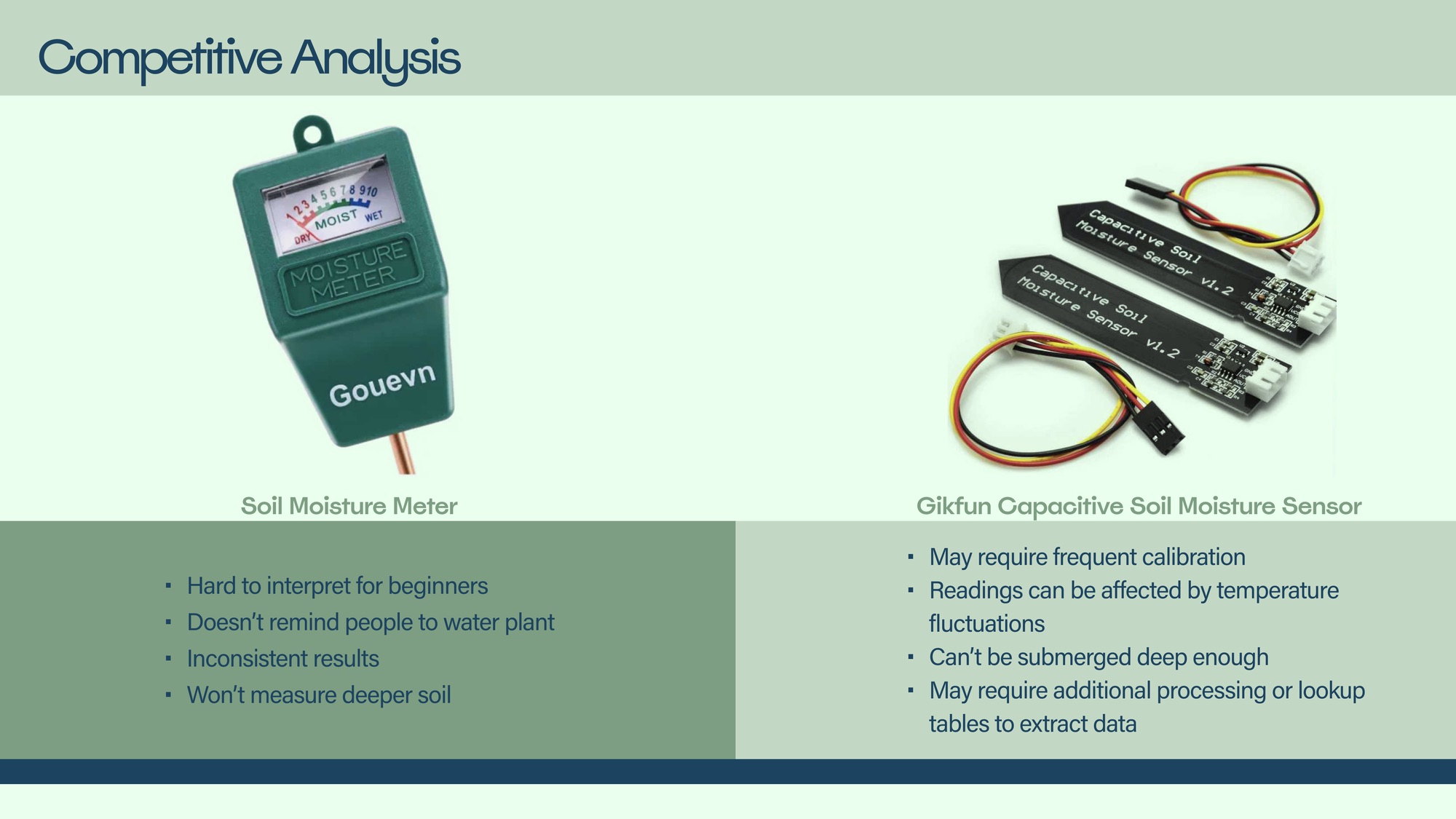
I compared the sensors people already buy (the Gikfun capacitive sensor, basic moisture meters) and watched them fail beginners: readings are hard to interpret, calibration drifts, and nothing reminds you or makes you care. Then I interviewed three plant owners. Each told a version of the same story: their plants didn't die because they didn't know how to care for them. They died because the relationship had gone cold.

Competitive analysis: Gikfun and Soil Moisture Meter limitations
Competitive analysis. Existing sensors fail beginners: hard to interpret, no reminders, unreliable readings for non-experts.
User interview: Anya Li, 16, plants as emotional therapy
Anya, 16. Uses plant shopping as emotional therapy. Plant death registers as neutral, an opportunity to restart, not a loss.
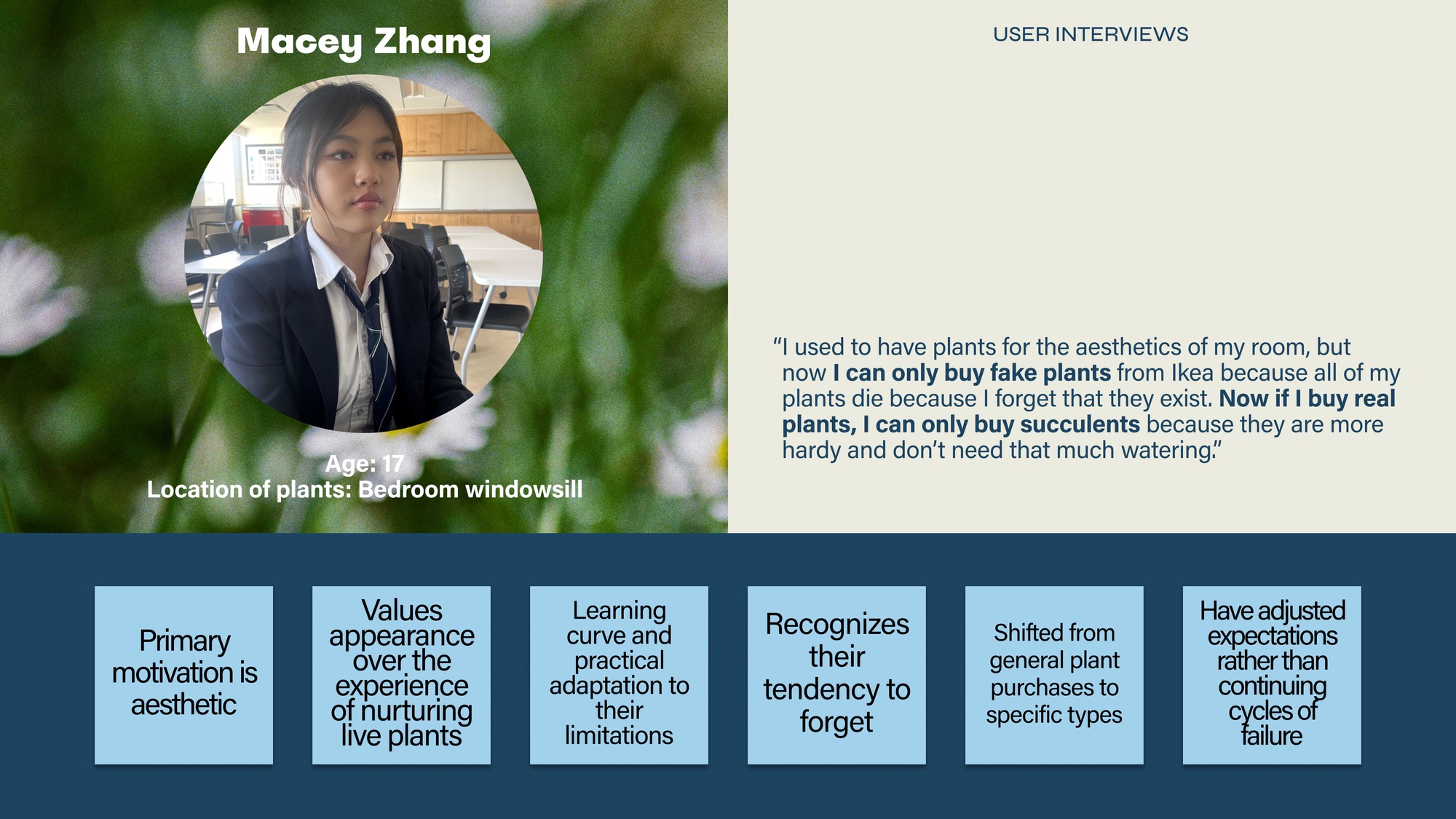
User interview: Macey Zhang, aesthetic motivation, switched to succulents
Macey, 17. Aesthetic motivation, plants as decor. Adapted by switching to succulents. Practical workaround over behavioral change.
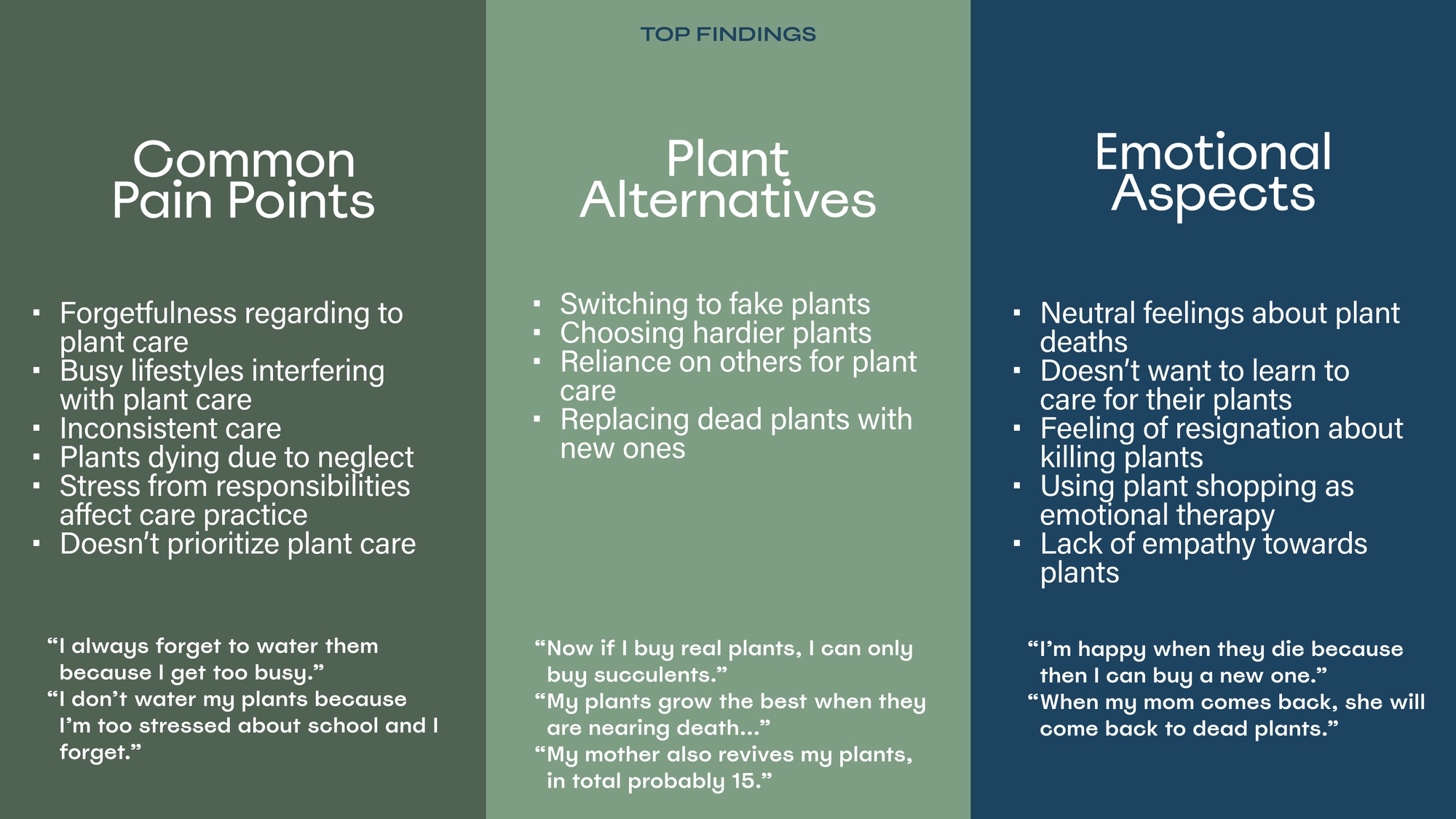
Insight clustering: plant alternatives and emotional aspects
Insight clustering. Two themes emerged: coping strategies (succulents, fake plants, relying on others) and emotional neutrality toward plant death.
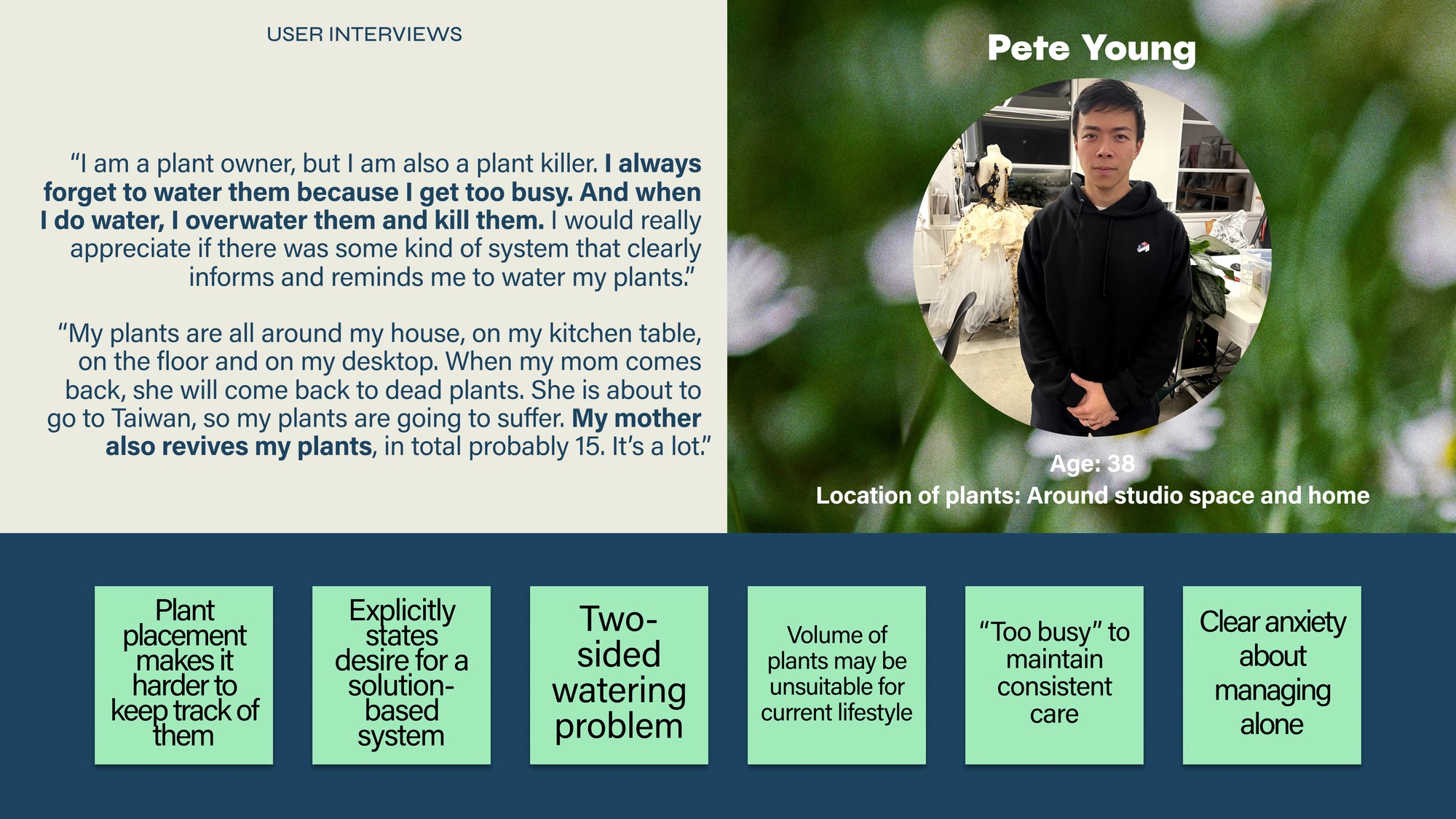
Pete Young interview: plant killer, overwatering, two-sided problem
Pete Young, 35. "I always forget to water them because I get too busy. And when I do water, I overwater them and kill them." Two-sided watering problem: both under and over.
What they wanted
  • Clear, low-effort reminders that don't feel like nagging
  • Feedback that tells them what to do, not just sensor numbers
  • A reason to check in (emotional connection, not obligation)
  • Forgiveness when they forget (hardy plants, low-maintenance species)
What pushed them out
  • Out of sight, out of mind (plants in corners, behind furniture)
  • No feedback until death was already imminent
  • Overwatering as often as underwatering, no confidence in timing
  • Existing apps felt like homework, not companionship
03

Three levers. One relationship.

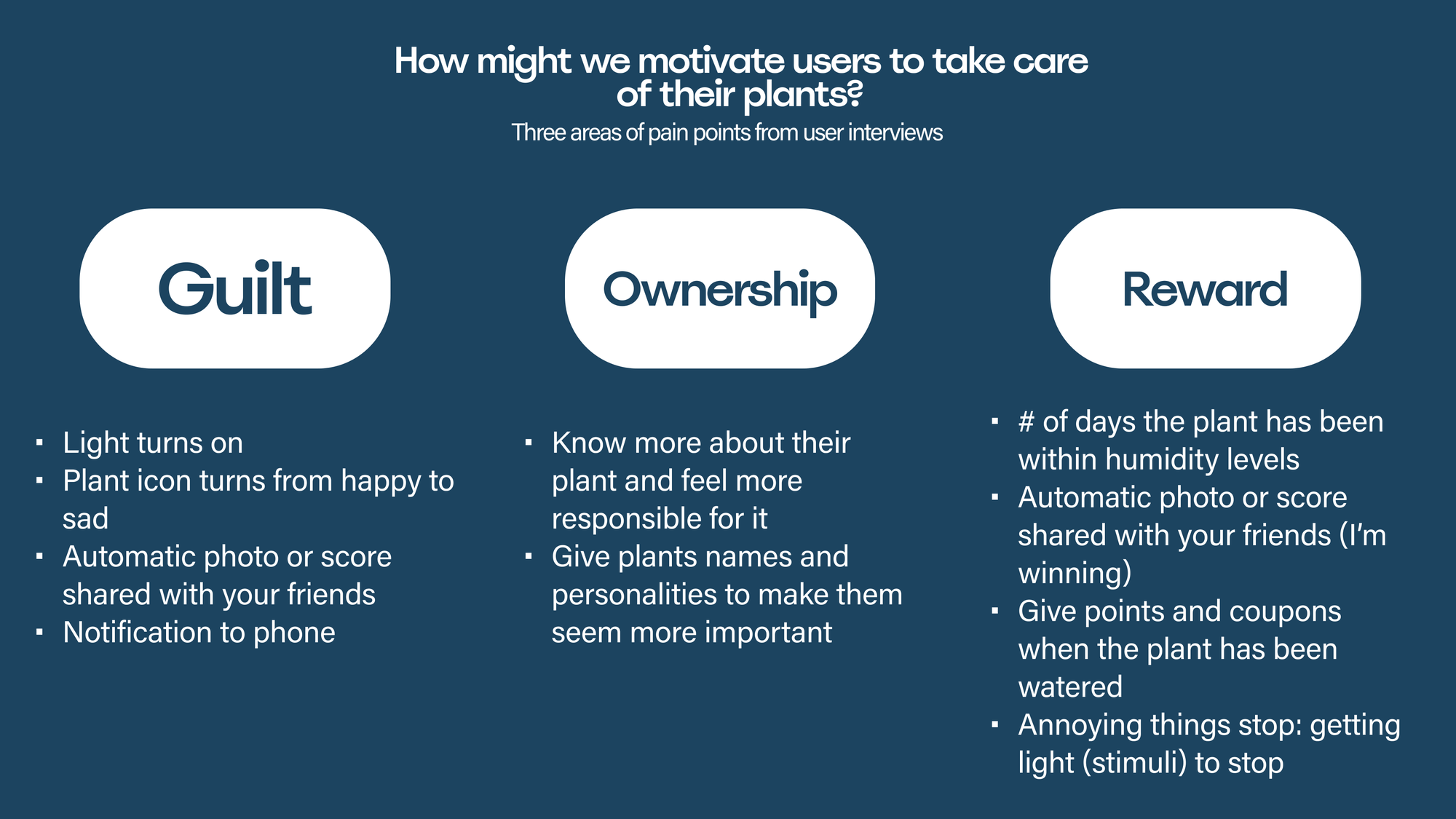
The research gave me one design target: build a relationship, not a dashboard. The interviews kept circling three psychological levers, and I made each one drive a part of the app.

Guilt
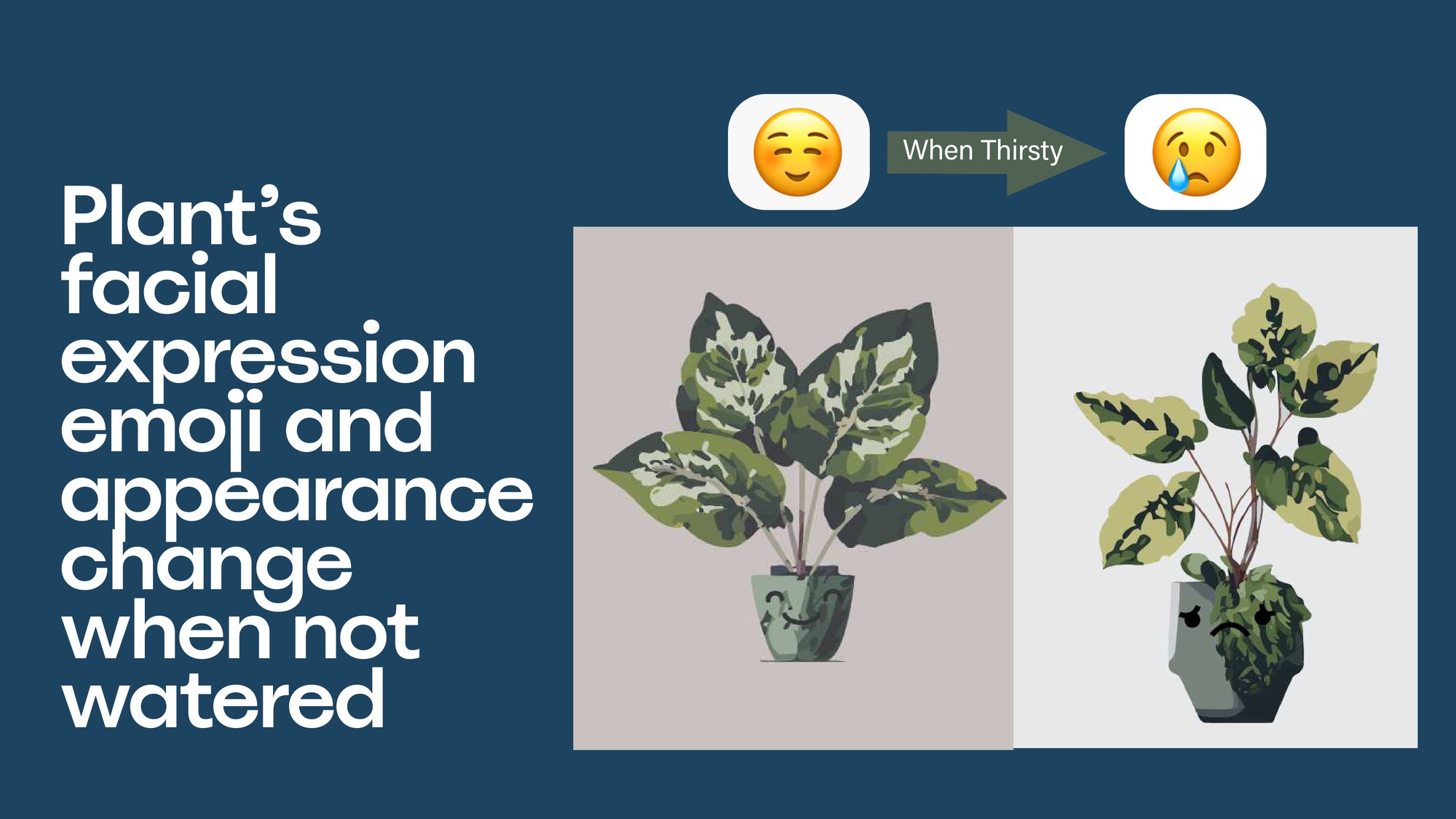
Make absence visible. When the soil goes dry, the LED turns on, the plant's face in the app icon drops from happy to sad, and the Friends feed tells everyone: "Pete is 9 days late on watering Todd: remind him now." The hardware, the interface, and your friends all flag you at once.
Ownership
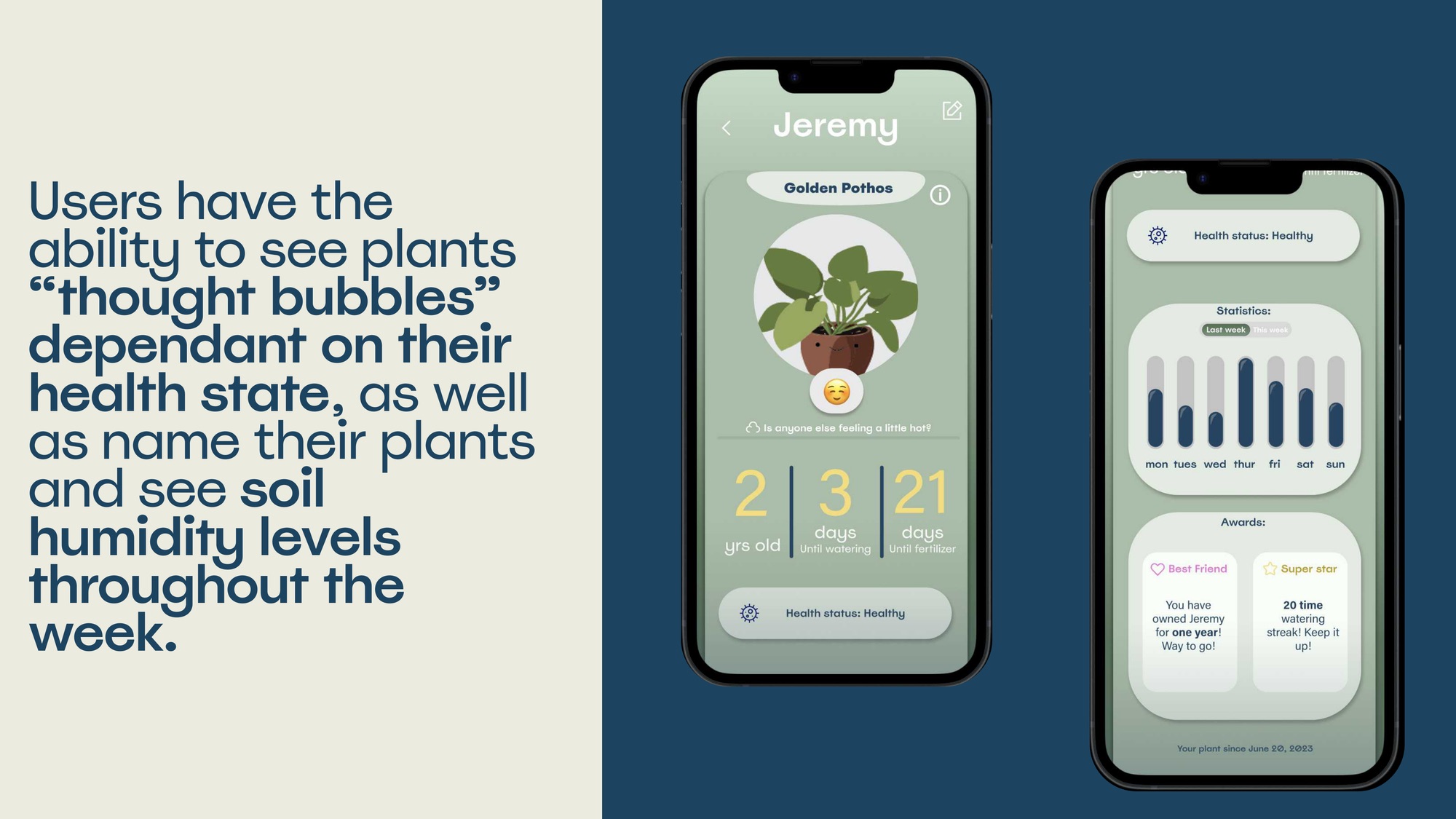
Give it a name, a species, a birthday. Each plant has a name (Jeremy, Todd, Bill), a species (Golden Pothos, Mini Monstera, Scarlet Ball Cactus), and an adoption date ("Your plant since June 20, 2023"). The detail screen tracks its age in years, days since you last watered it, and days until the next fertilize. Once a plant has a name and a history, you stop letting it slip your mind.
Reward
Make care pay off. Points accumulate with each watering (320 pts shown in testing). Hit a threshold: redeem real coupons: "15% off fertilizer at Home Depot." Badges mark milestones: "Best Friend" (owned for one year), "Super star" (20-time watering streak). The friends feed also runs positive: "Robert just watered Finn: congratulate him on his 4 time streak!"
Three motivation arcs: Guilt, Ownership, Reward

Fig. 02: Motivation framework: how each lever triggers care behavior

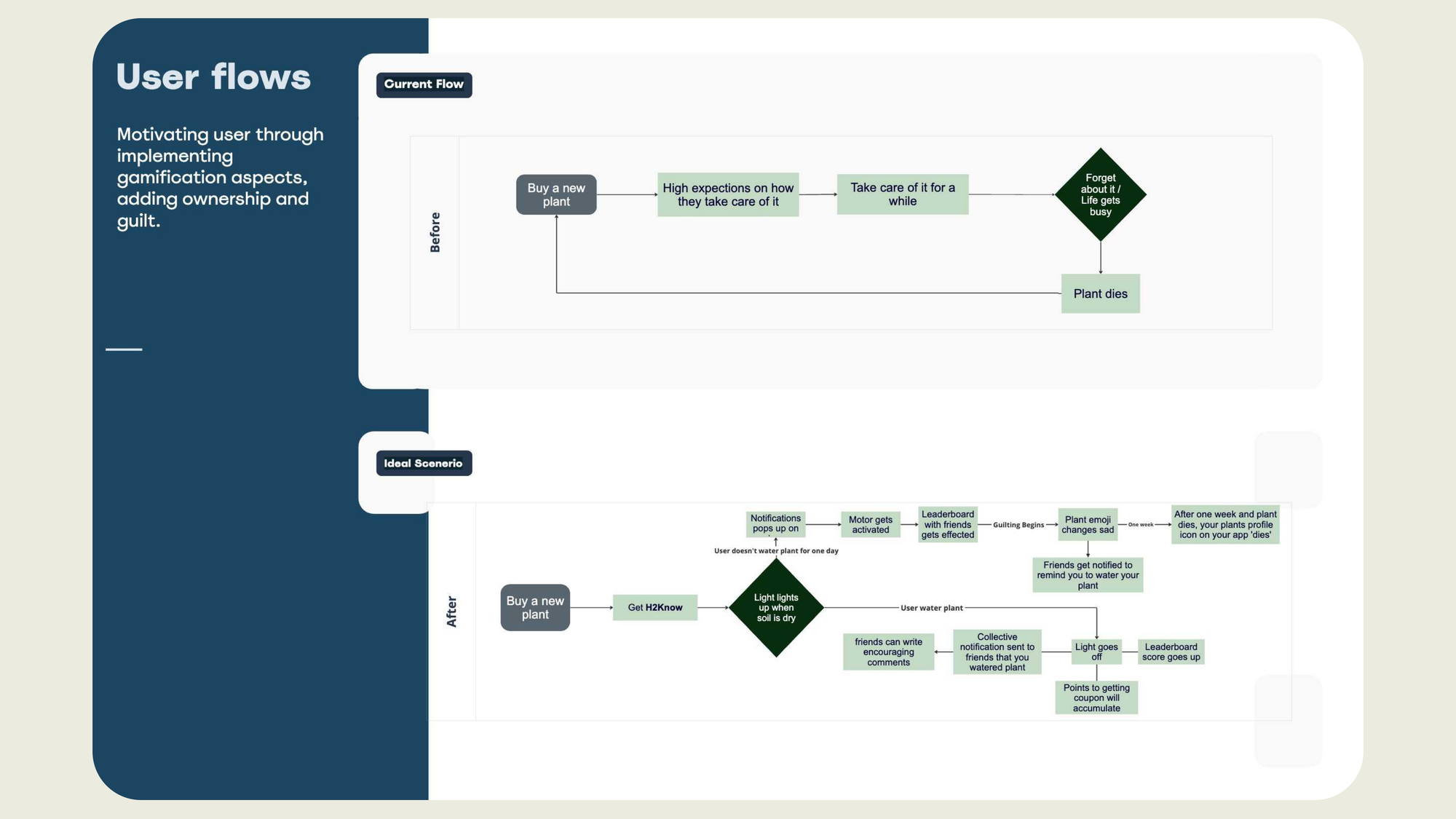
User flow: Before (plant dies) vs Ideal Scenario with H2Know system, notifications, leaderboard, guilt loop, coupons

Fig. 03: Before vs after: how H2Know intercepts the abandonment loop

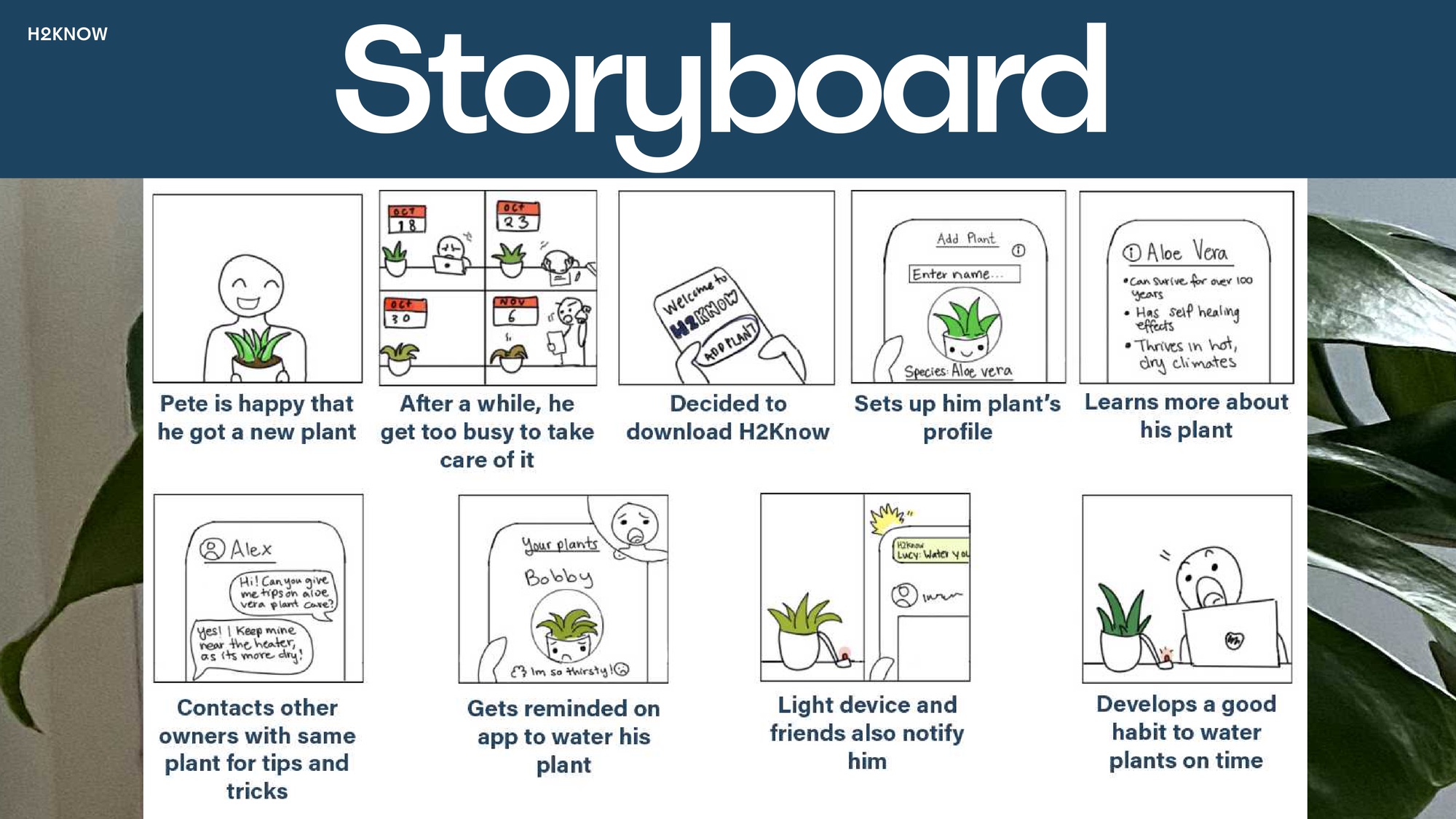
Storyboard: Pete buys plant, gets busy, downloads H2Know, sets up profile, gets reminded, light and friends notify, develops good habit

Fig. 04: Storyboard: from "gets too busy" to "develops a good habit"

04

Hardware + app as one system.

H2Know is a two-part system: an Arduino Nano with a capacitive soil moisture sensor that detects dry soil and signals via LED, paired with a five-screen companion app that visualizes plant health, handles the social layer, and converts consistent care into real-world rewards.

Home
Your plant list: each plant shown with its emoji avatar face, name, and species. The face state (happy / neutral / sad) updates based on sensor data. Adding a new plant opens a 5-minute survey that recommends the right species for your space and habits.
Water Today
Two-column view: "To water" (Todd, 100 ml) next to "Completed" (Jeremy, checkmark). You read the day's task in one glance, without digging through a list.
Plant detail
Age, days without water, days until fertilize, health status bar, weekly watering chart by day. Awards live here: "Best Friend" (one year), "Super star" (20-streak). Plant birthday shown at bottom.
Friends
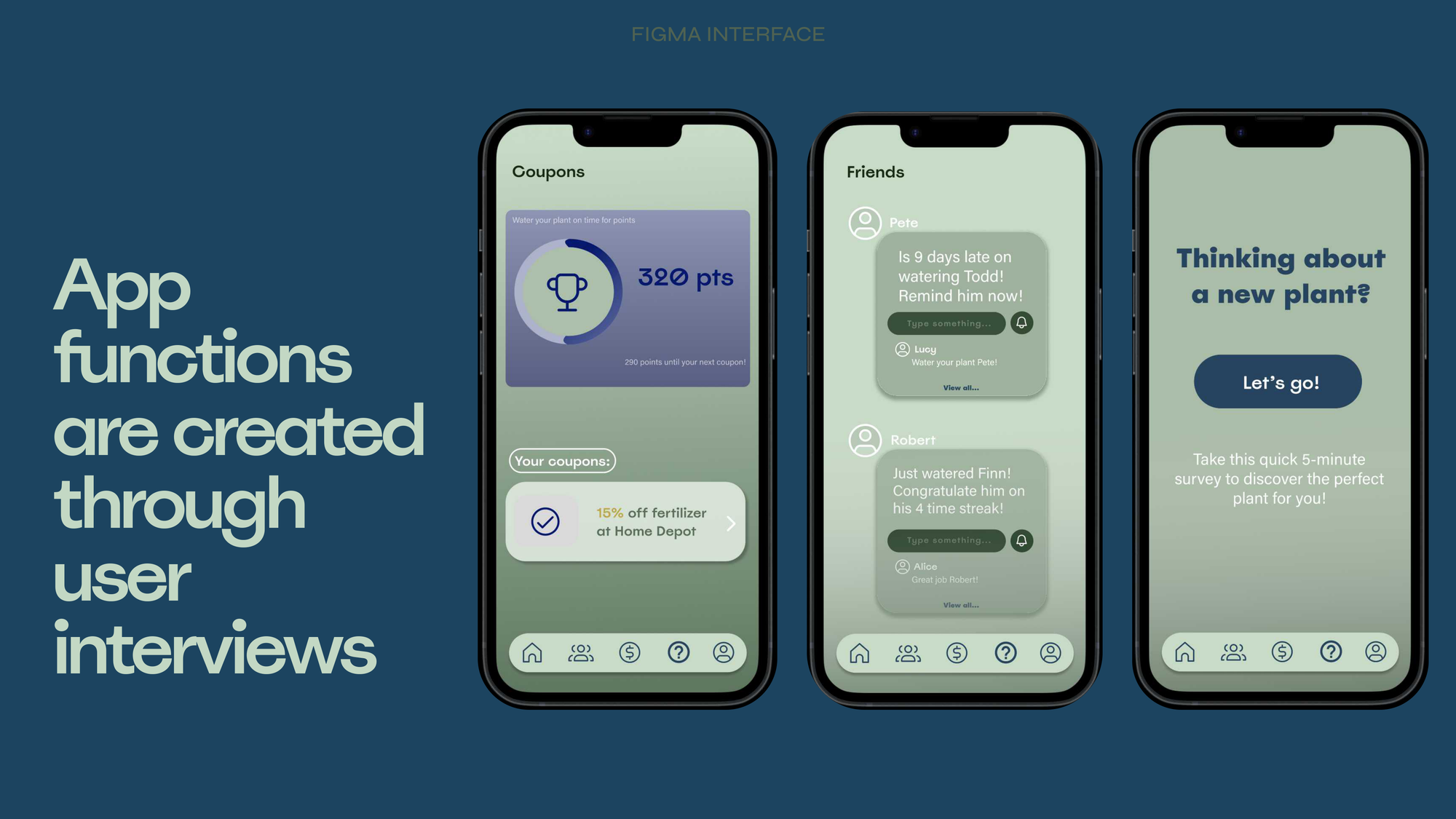
Social accountability feed. Late watering generates a public flag and a "Remind him now" prompt. Streaks generate congratulation prompts. Both directions (shame and celebration) come from the same screen.
Coupons
Points accumulate per watering. At threshold, real coupons unlock: "15% off fertilizer at Home Depot." Progress bar shows points to next reward. Redeemed coupons stay visible as record of care.
5
Screens: Home, Water Today, Plant Detail, Friends, Coupons. Each built around one motivation lever.
67%
Of millennial plant owners self-identify as "plant murderers," the emotional failure H2Know targets with guilt, ownership, and social accountability
$15
Approximate cost of the Arduino hardware kit, the entire physical layer for a market where "smart" planters retail at $60–120
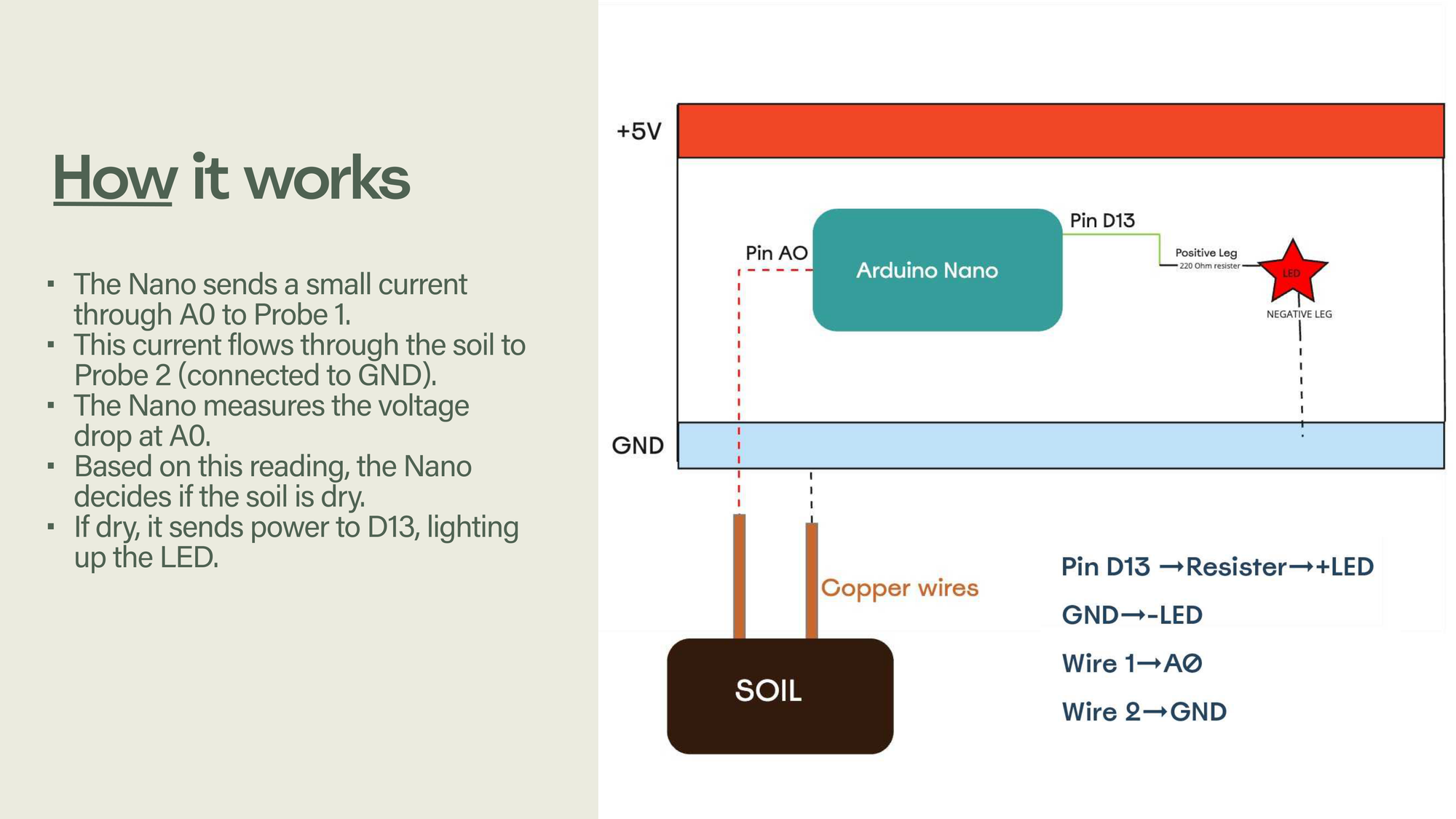
Arduino circuit diagram: Pin A0 moisture probe, Pin D13 LED trigger, copper wire probes in soil
Circuit diagram. Nano passes current through A0 → Probe 1 → soil → Probe 2 → GND. Voltage drop at A0 determines moisture. When dry: D13 powers the LED via 220Ω resistor.
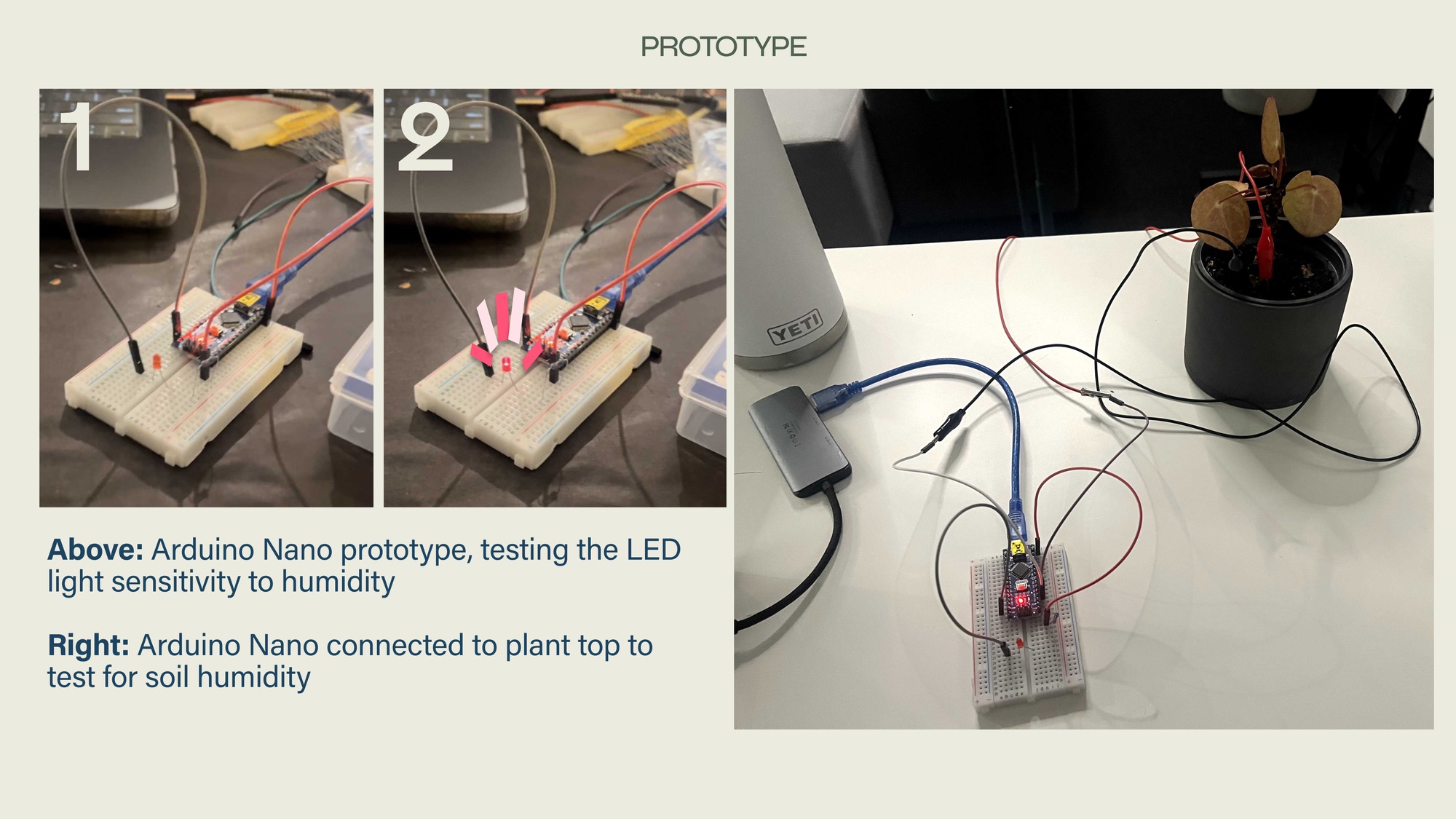
Physical prototype: Arduino Nano testing LED sensitivity with humidity, connected to plant pot
Hardware prototype. LED sensitivity testing (photos 1+2) and final hookup with copper wire probes buried in a live plant pot. USB powered, no cloud dependency.
App UI: plant thought bubbles and mood-based personality states
Plant personality. Named plants (Jeremy, Todd, Bill) with emoji faces, happy when healthy, sad when dry. Thought bubbles communicate need through character, not data labels.
Storyboard: three simultaneous guilt triggers when plant goes dry
Three-trigger guilt loop. When soil is dry: LED activates, app icon shifts to sad face, Friends feed flags the neglect publicly. All three fire at once.
Figma hi-fi screens: Water Today, Plant Detail with awards, Friends feed, Coupons
Hi-fi screens. Water Today (to water / completed split), Plant Detail (age + stats + badge awards), Friends (accountability feed), Coupons (320 pts → 15% off Home Depot).
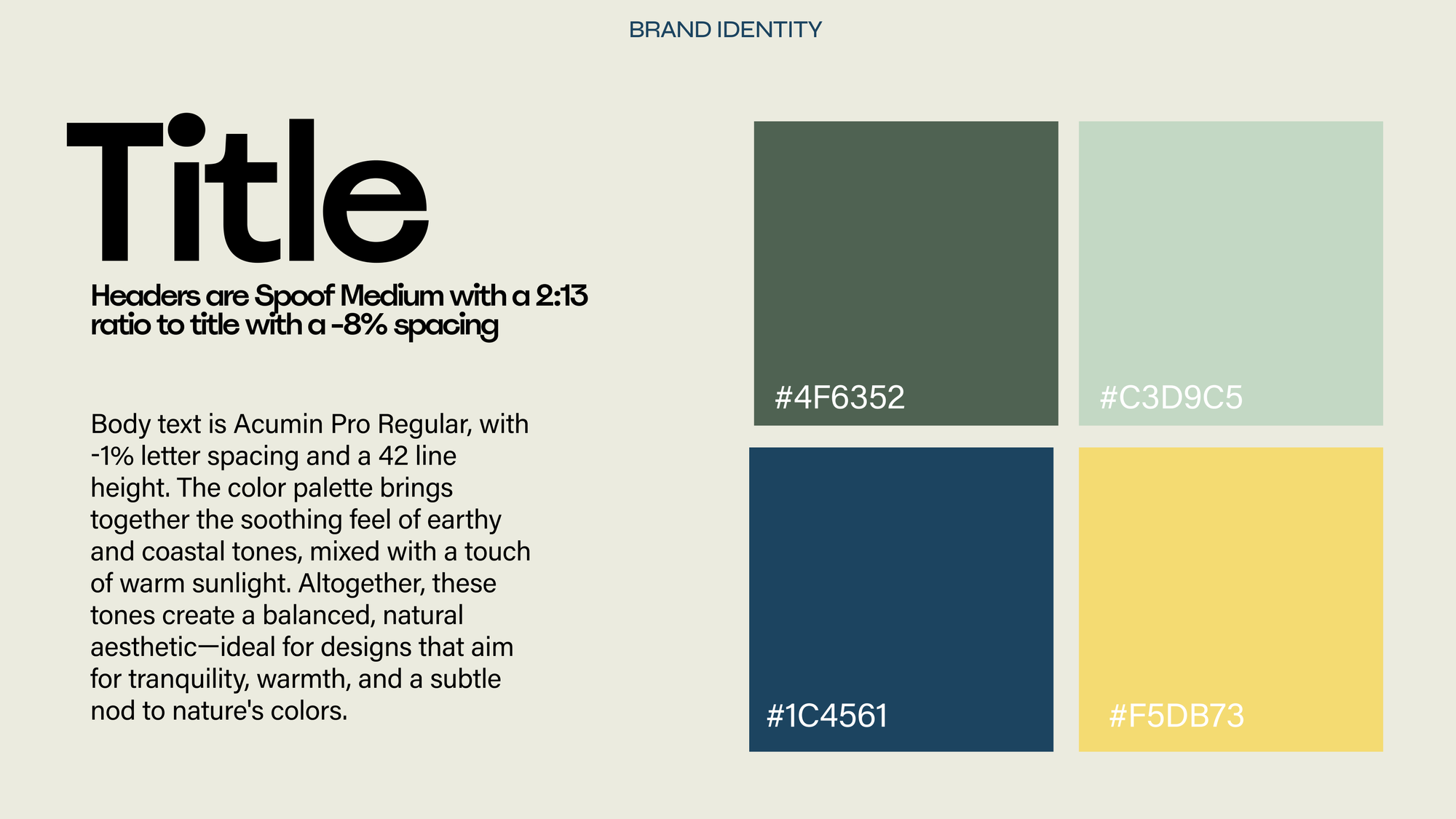
H2Know brand identity: Spoof Medium, earthy palette: sage, deep teal, warm yellow

Fig. 05: Brand identity: earthy palette (sage, deep teal, warm yellow) and Spoof Medium type

05

What I'd do differently.

The naming mechanism deserved more design time.

Every interview pointed the same way: named plants outlive unnamed ones. Yet in the prototype I made naming a plain text field on the setup screen. If I framed it as a small ritual instead, with onboarding that treats the name as the start of a bond, the ownership lever would kick in from the very first tap.

Hardware and software need to be co-designed, not sequential.

I built the Arduino prototype and the Figma app in separate phases. So I designed the hardware without knowing which app interactions it would trigger, and designed the app without knowing how slow the sensor actually was. Next time I'd prototype the physical and digital sides side by side from week one.

Two features didn't make the build; both would have changed the testing.

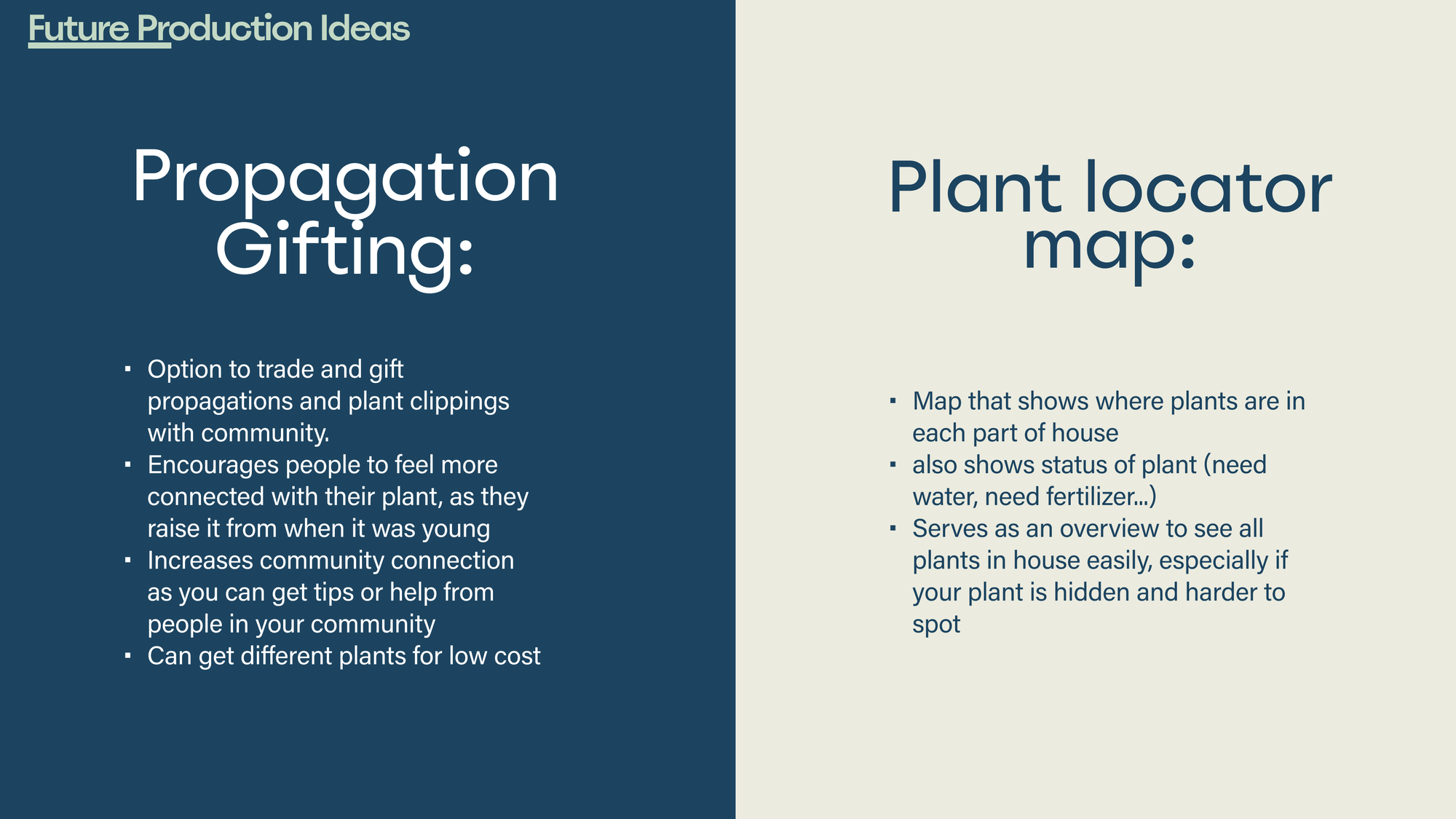
I cut two features from the prototype: a plant locator map (which plant in the house needs water, based on sensor placement) and a propagation gifting system (trading clippings with other owners). Both go straight at the out-of-sight problem. The locator surfaces the plants you've stopped seeing, and gifting raises the social stakes of keeping yours alive. I'd build both in v2.

Future production ideas: Propagation Gifting and Plant Locator Map

Fig. 06: Future production ideas: community gifting and in-home plant locator

Related project

Eternal Wreckening

The Eternal Wreckening takes the same habit-loop logic into a physical, real-time game. Like H2Know, it designs for behavior that repeats and shifts over time, with the feedback wired into the system itself.